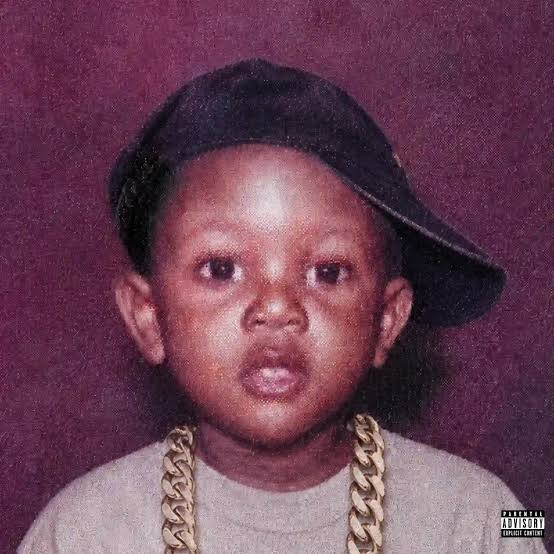

By the time artists of this stature arrive at a joint album, the work is rarely about possibility anymore. It is about confirmation. Of chemistry already proven in fragments. Of audiences already conditioned to the pairing. Of a musical relationship that has outlived novelty and entered something closer to instinct.
This is the case of famous West African singers, Mr Eazi, and King Promise. Their much awaited joint body of work ‘See What We’ve Done‘ exists squarely in that space of assuredness.
The pairing of Nigeria’s Mr Eazi and Ghana’s King Promise is historically legible. Both artists have spent years refining adjacent but distinct approaches to Afropop’s romantic core—Mr Eazi through understatement and tonal restraint, Promise through melodic plushness and vocal saturation. Together, they contour each other beautifully.
From the opening “Where Have You Been?”, the record signals its governing aesthetic: emotional continuity rather than rupture. The track is unhurried, structurally sparse, and deliberately conversational in tone. It does not announce itself as an opener so much as it resumes a dialogue already in progress.
That sense of familiarity is sharpened on “That Way,” which reworks the melodic architecture of Backstreet Boys’ I Want It That Way. The interpolation is treated as translation, an act of cultural softening rather than reinvention. It is effective precisely because it avoids excess ambition. Yet that same restraint also defines its limitation: the record is fluent, but rarely disruptive.
Across “Mariana” and “Taste,” the album settles into its most convincing register. These are songs built on atmospheric clarity and melodic ease, supported by production from a tight circle including GuiltyBeatz and JAE5. The sonic design is spacious, allowing both vocalists to operate within a shared emotional temperature rather than competing for tonal dominance. The results are polished and assured, though they rarely strain beyond the expected contours of either artist’s established strengths.
There is a recurring sense across the record that everything has been meticulously optimised for coherence. What it gains in elegance, it occasionally loses in volatility.
Midway through, “Criminal” and “No. 1 Fan” introduce a more kinetic register, leaning into rhythmic immediacy and performance-ready energy. These tracks broaden the album’s emotional range, though they remain structurally conservative, extensions of mood rather than departures from it.
If the album finds its most human moment, it is on “Baby I’m Still Jealous.” Here, emotional articulation is less stylised. Jealousy is framed as residual feeling, softened by maturity, tempered by time. It is one of the few moments where the writing allows friction to surface without smoothing it away.
“Mad Ting” briefly unsettles the album’s mid-tempo equilibrium, introducing dancehall inflections and a more extroverted rhythmic vocabulary. It is one of the few instances where the project feels less like calibration and more like movement.
By the time the title track “See What We’ve Done” arrives, the album has fully clarified its thesis. This is not a record concerned with reinvention or risk. It is a document of alignment, of shared history rendered into present-tense form.
The album’s production framework, anchored by figures such as KillBeatz alongside GuiltyBeatz and JAE5—ensures a sonic consistency that is near immaculate. The mixes are clean, the arrangements disciplined, the transitions seamless. At times, this precision becomes its defining aesthetic: everything is placed exactly where it is meant to be, and nothing is allowed to disturb that equilibrium.
And that is ultimately the defining tension of See What We ’ve Done.
See What We’Ve Done’ is an album shaped by camaraderie so refined it becomes structure, and chemistry so assured it becomes method. Mr Eazi and King Promise refine what already works between them. The result is a body of work that is elegant, coherent, and deeply self-aware, an exercise in restraint as artistic philosophy.
If there is a critique to be made, it is not of execution, but of risk appetite. The album rarely steps outside its own carefully drawn boundaries. But within those boundaries, it is exceptionally composed.What remains is a record that understands exactly what it is: not a reinvention, but a consolidation.