There is something deceptively cheerful about Chukwudi Nwachukwu’s The Hills That Raised Us. Children smile. Groundnuts and bananas sit carefully balanced on metal trays. Behind them, the hills of Uturu recede quietly into the distance. At first encounter, these could simply be portraits of young hawkers going about an ordinary day in southeastern Nigeria. Stay with the photographs for slightly longer, however, and another conversation begins to emerge.
Nwachukwu is interested in what happens when childhood meets responsibility earlier than expected.
Made in Uturu, Abia State, in March 2025, The Hills That Raised Us finds the photographer observing children who hawk goods while away from school. Yet Nwachukwu avoids approaching his subjects as anonymous evidence of a social problem. His interest remains where much of his earlier photography has been strongest: with the individual standing before his camera.
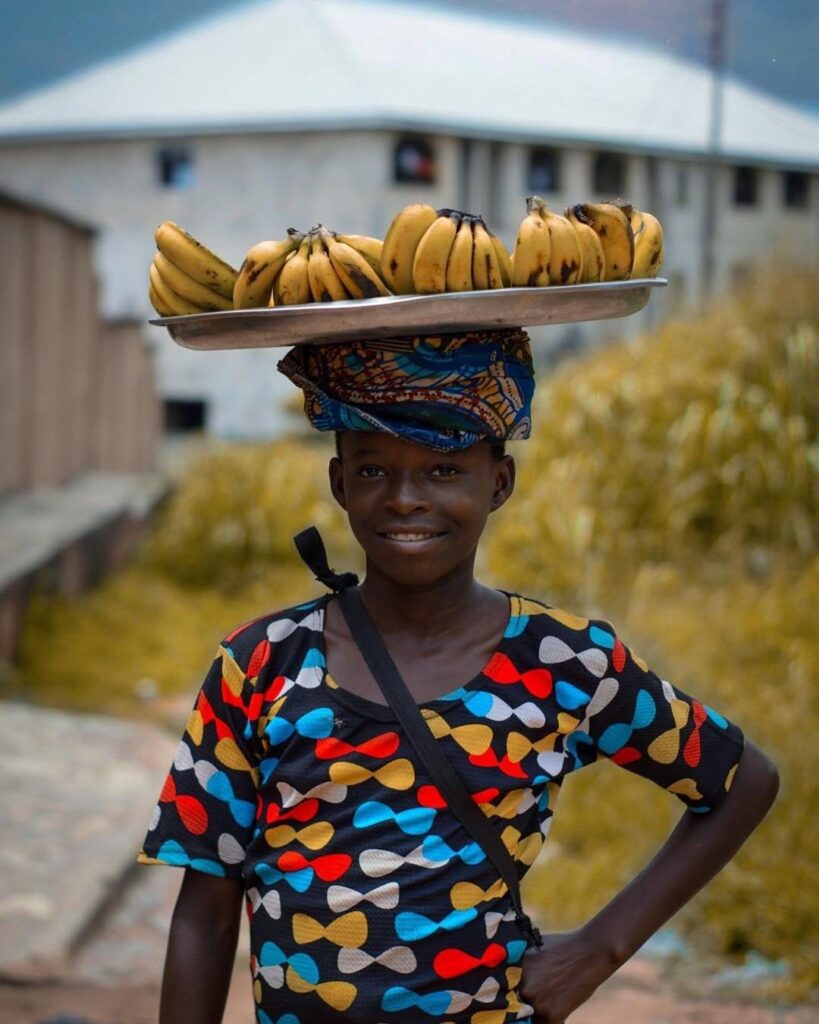
One photograph presents a young girl carrying bananas. She stands squarely before Nwachukwu, one hand resting confidently against her waist while the tray occupies almost the entire width above her head. Her patterned clothing introduces bursts of red, blue and yellow against the comparatively muted vegetation behind her. She is smiling, but not performing helplessness for the camera. There is an ordinary confidence to her posture.
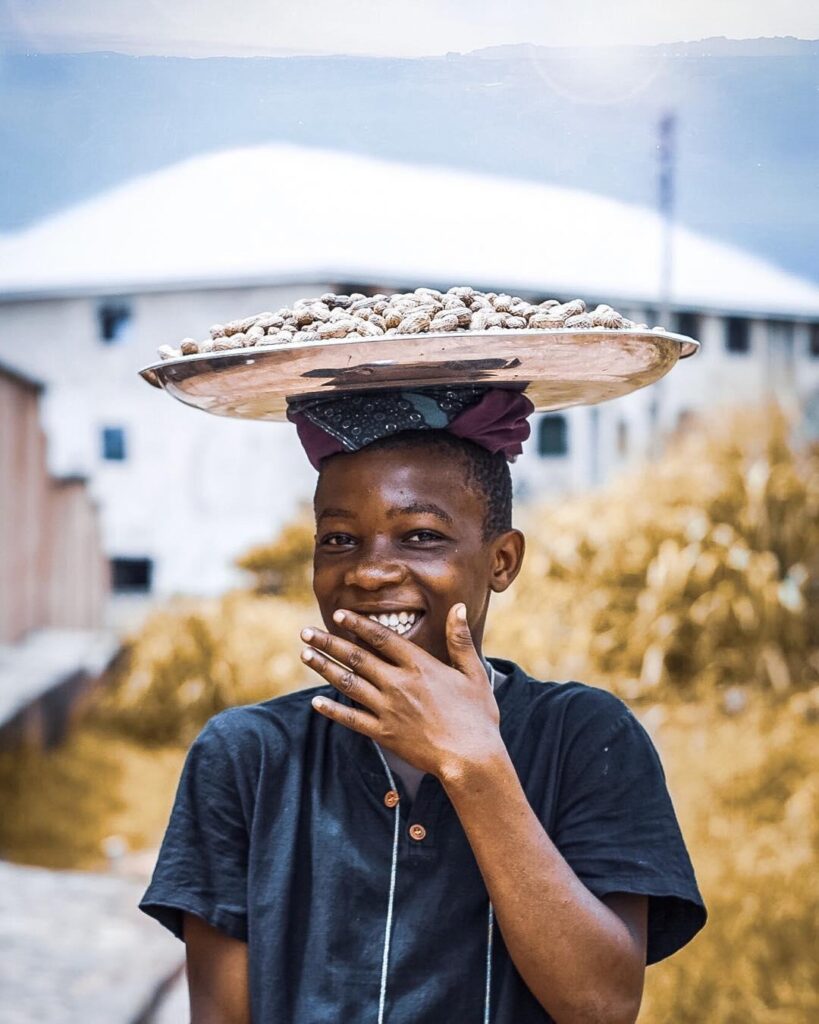
Another young hawker carries groundnuts. Her hand rises towards her mouth as she breaks into a smile. The gesture matters. It interrupts the formality of the portrait and allows something less controlled into the frame.
This negotiation between construction and spontaneity is becoming familiar territory for Nwachukwu.
His 2023–2024 series Soft Bodies, Hard World similarly relied upon portraiture to examine a broader social concern. There, Nwachukwu photographed women while considering the limitations imposed upon them by patriarchal expectations. Those photographs could be deliberately constructed, sometimes shifting between monochrome and heavily warmed colour as a young photographer experimented with how emotion could be produced visually.
The Hills That Raised Us does not abandon that approach. Instead, it refines it. The portraits remain staged. The subjects know they are being photographed. Composition remains controlled. But Nwachukwu appears increasingly willing to allow the person before him to disrupt whatever photograph he initially imagined. A smile, a hand across the mouth or an unexpectedly relaxed posture becomes as important as the photographer’s arrangement of the frame.
It is in the black-and-white portrait, however, that the project finds its emotional center. A boy stands underneath an almost empty tray, both arms raised to support it. He smiles broadly into Nwachukwu’s camera. Behind him sits the familiar architecture and distant landscape of Uturu, rendered softly enough that our attention remains fixed on his face. The boy’s name is Chukwudi.
For the photographer, that coincidence changed the encounter. The young Chukwudi explained that he was hawking during his break from school, earning money to support himself and his parents while waiting for another school term to begin. Nwachukwu recognized something of himself in the story. Growing up in Aba, a city whose commercial identity is inseparable from making, trading and work, he had also encountered ideas about labour and responsibility early.
Suddenly, The Hills That Raised Us becomes more than a photographer observing children whose lives differ from his own. It becomes an act of recognition. That distinction is important because photographs of working African children can very easily collapse into familiar visual languages of deprivation. Nwachukwu’s photographs occasionally sit dangerously close to that territory simply because of their subject matter. Yet his most successful images resist it by refusing to make hardship the entirety of the child’s identity.
The black-and-white portrait is particularly successful for this reason. The boy is working, certainly. The tray tells us that immediately. But Nwachukwu has photographed something else alongside the labour: personality. The enormous smile refuses the single emotional reading that the circumstances might otherwise encourage.
There is no attempt to suggest that smiling somehow makes the burden insignificant. Rather, contradictory realities are permitted to occupy the same photograph.mA child can work and still laugh. A difficult circumstance does not consume an entire identity.
More Than a Backdrop
The title provides the series with its larger metaphor. Uturu is a hilly town, and the landscape remains present throughout Nwachukwu’s photographs without becoming their principal subject. Buildings, vegetation and distant elevations dissolve behind sharply rendered faces.
For Nwachukwu, however, these hills are doing conceptual work. “The hills are not just scenery,” he explains. “They represent the environment that raises people, not just where they live.” It is a simple proposition, but one that expands the series considerably. Parents raise children. Families raise children. But so do economies, streets, towns, expectations and circumstances.
Place becomes an invisible participant in childhood. This also explains why The Hills That Raised Us feels more personal than Soft Bodies, Hard World. The earlier project demonstrated Nwachukwu’s desire to use photography to speak about social experience. Here, he begins locating himself inside the questions he photographs.
He is not claiming the children’s experiences as his own. Rather, an encounter activates memory. The young hawker named Chukwudi becomes a point at which another person’s story unexpectedly brushes against the photographer’s.
Finding a Language
Perhaps the more interesting development is that Nwachukwu appears less preoccupied with finding external references for what his photography should become. Earlier in his development, he readily identified photographers such as Sodiq Adelakun among the figures who encouraged him to take photographic storytelling seriously. With The Hills That Raised Us, his reference point appears to be shifting inward.
Nwachukwu says that while making the project he was becoming increasingly influenced by what his own photographs were teaching him. That confidence should not be mistaken for arrival. There are still questions within the work. The repeated frontal compositions risk becoming predictable when viewed as a sequence, and the relationship between fine-art construction and social documentary remains something Nwachukwu is negotiating rather than something he has completely resolved.
But perhaps resolution would be premature. What appears to be emerging instead is a set of instincts. Nwachukwu likes people. He likes faces. He likes the tension between an individual’s private experience and the larger environment surrounding them. Most importantly, he appears increasingly convinced that storytelling rather than pure aesthetic experimentation may be the strongest foundation for his photography.
By March 2025, that understanding finds him at an interesting point in an emerging career. He is submitting photographs to open calls and competitions and attempting to place his practice before audiences beyond Nigeria. Whether those ambitions translate into anything substantial remains outside the photographs themselves.
What The Hills That Raised Us demonstrates is considerably simpler. A photographer who began by wanting to preserve other people’s stories is slowly discovering that the stories which affect him most may be those in which observation unexpectedly becomes recognition.
The hills behind these children therefore do not function as monuments. They barely demand our attention at all. They simply remain there. And perhaps that is Nwachukwu’s point. The environments that raise us rarely announce what they are doing while we are still inside them. We understand their weight much later, when we encounter something or someone. that makes us look back.