There is a peculiar contradiction in the language often used to describe African women. They are called strong, resilient, industrious, enduring. The words sound complimentary until one begins to consider what they require of the women being described. Strength can become an expectation. Resilience can become permission for hardship to continue. Sometimes, to celebrate someone’s capacity to endure is to avoid asking why they must endure so much in the first place.
It is somewhere inside this contradiction that emerging Nigerian photographer Chukwudi Nwachukwu situates Soft Bodies, Hard World, a portrait series photographed between 2023 and 2024 across parts of Abia and Rivers states.
The project is concerned with women and the social structures that attempt to determine the boundaries of their lives. Patriarchy is its most explicit target, although Nwachukwu approaches the subject less through documentation of acts of discrimination than through portraiture and the emotional presence of the women themselves.
His original statement for the project is remarkably direct: “So many women are determined in life and powerful but are limited due to the societal norms and belief.” He concludes with an equally straightforward appeal: “Let’s give women a chance to help contribute in the growth and development of the nation.”
There is youthful idealism in that statement. There is also an emerging photographer beginning to understand that the camera can be used for something beyond making attractive pictures. That distinction matters.
The face as testimony
One of the strongest photographs in the series is also one of its simplest. A young woman wearing a dark head covering occupies almost the entire black-and-white frame. Nwachukwu comes close. There is little environmental information to distract from her. Her face is centred, her expression controlled, and her eyes meet the camera directly.
Nothing dramatic is happening. That is precisely why the portrait works. Nwachukwu refuses the more obvious visual vocabulary that could have accompanied a project about marginalisation. There are no chains, no theatrical representations of oppression, no attempt to transform the sitter into an uncomplicated victim. Instead, we are confronted with a woman looking back.
The relationship between photographer and photographed becomes important here because Nwachukwu says getting his subjects comfortable was among the greatest difficulties he encountered while making the series. “My approach to composition is talking to my subject about what we are working on and allowing them to be free while I photograph,” he explains. This becomes visible in the photographs. They are staged, certainly, but the strongest images do not feel over-performed.
Another black-and-white portrait complicates this approach. A woman in glasses, wearing a checked shirt with a strap crossing her torso, looks slightly upwards rather than directly towards us. The background is rendered softly enough that the face remains dominant, but unlike the almost symmetrical stillness of the first portrait, this photograph feels unsettled. Her expression is difficult to resolve. Perhaps that uncertainty is useful. Portraiture does not always have to explain its subject.
Vulnerability without spectacle
Nwachukwu’s recurring interest in facial expression becomes more pronounced in another portrait of the woman in the head covering. This time her eyes are closed. Both hands rise towards her head, and what appears to be a tear is visible on her cheek. Here, Soft Bodies, Hard World comes closest to making its central metaphor literal.
The body is present as something vulnerable; the world that supposedly produces this emotional condition remains outside the frame. It is an interesting decision because the photographer asks the viewer to infer the pressure rather than witness its source. The photograph consequently operates less like conventional documentary photography and more like a psychological portrait.
Nwachukwu admits that emotion was central to what attracted him photographically. “I was interested in the feelings I saw on the faces of my subjects, and I wanted viewers to see that too,” he says. “I was experimenting with my camera, light and emotions.”
There are limitations to this strategy. A photograph of sadness cannot, by itself, explain patriarchy. Neither can a portrait automatically become evidence of the social conditions described in an accompanying statement. At moments, Soft Bodies, Hard World asks its concept to carry more sociological weight than the photographs themselves can independently support. But Nwachukwu appears less interested in producing evidence than in producing recognition. The difference is significant.
Softness as another form of strength
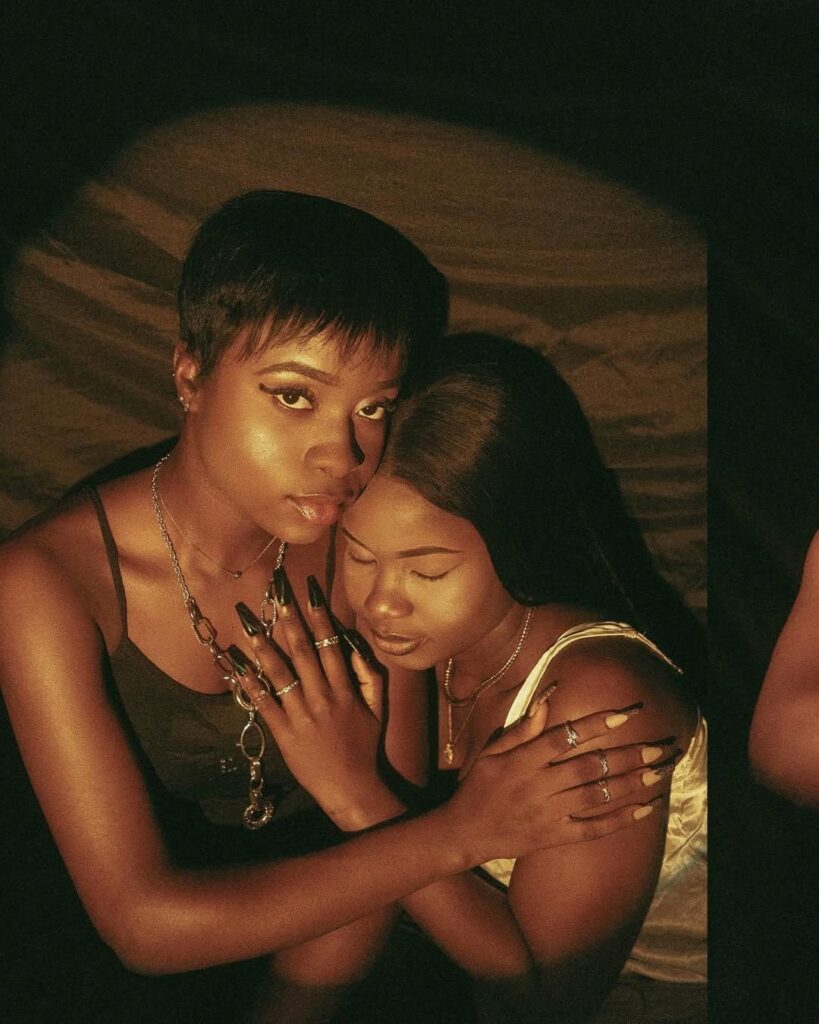
Two warmer, colour photographs move the series somewhere else entirely. Two women occupy a dark interior. One rests against the other while an arm moves protectively across her body. Their jewellery, clothing, manicured nails and carefully constructed appearance could easily have pushed the photograph towards fashion imagery, yet their physical relationship changes its emotional register.
One woman looks directly at the camera. The other closes her eyes. Protection and vulnerability occupy the same photograph. In another frame, Nwachukwu pulls slightly wider. The embrace remains, but the photograph becomes less confrontational. There is a tenderness here absent from the solitary portraits. The warm, almost amber treatment of the image heightens this intimacy and separates these pictures visually from the cooler black-and-white photographs elsewhere in the project.
The stylistic movement is not entirely seamless. At this stage in his practice, Nwachukwu appears to be testing several photographic languages simultaneously: straightforward portraiture, conceptual staging, monochrome studies and more stylised colour work. This unevenness is not necessarily a weakness. It is evidence of experimentation.
The more interesting continuity lies elsewhere. Across the different approaches, Nwachukwu repeatedly returns to proximity. He wants to get close to people. Faces dominate his frames. Bodies overlap. Hands touch heads, shoulders and chests. Backgrounds frequently surrender their importance. The person comes first.
Photography as a way of listening
Nwachukwu’s interest in storytelling predates this particular series. By the time he began Soft Bodies, Hard World, he had already been practising photography seriously and experimenting with individual fine-art images. But this project represents a more deliberate attempt to build several photographs around one sustained idea.
Why photography? “Everyone has a story to tell and that alone is a goldmine for generations to come,” he says. “I began photography because I wanted to use my images to tell stories that people never knew about and preserve these stories.”
It is an ambitious answer, particularly for a photographer still developing his practice. But ambition is perhaps the appropriate condition for an emerging artist. The more revealing part of his process concerns access. Nwachukwu approached the women, explained what he was attempting to make and photographed them only after establishing some degree of understanding. He says some initially held back emotionally or became uncomfortable in front of the camera.
This created a practical problem. The project required vulnerability, but vulnerability cannot simply be demanded because a photographer has arrived with a camera. He had to wait. He had to talk. He had to make people comfortable.
That process points towards something potentially more important than the project’s explicit message about patriarchy: Nwachukwu is learning that portrait photography is partly an exercise in negotiation. The camera records the relationship as much as it records the face.
An emerging language
Nwachukwu cites photographer Sodiq Adelakun among his early inspirations, alongside the environments in which he grew up. But Soft Bodies, Hard World does not yet feel like the work of a photographer who has settled into one rigid visual formula. That may be its advantage.
There are places where the concept could be pushed further. The relationship between the women’s individual experiences and the larger patriarchal structures invoked by the project could be made more specific. Greater environmental context might also allow some portraits to communicate aspects of the women’s worlds that faces alone cannot provide.
Yet there are already instincts worth watching. Nwachukwu understands faces. He understands proximity. More importantly, he appears interested in what happens immediately before a person performs for the camera and what remains when that performance begins to fall away.
The ambition now extends beyond making the photographs. “I hope to see my work in places I never expected, even if that means beyond Africa,” he says. He wants the series exhibited. He wants the photographs encountered in print and at festivals. He wants to sell work, discuss it publicly and build a practice capable of travelling nationally and internationally.
Whether Soft Bodies, Hard World becomes the project that accomplishes all of that is impossible to know in 2024.
Perhaps that is beside the point. The more interesting development is that Nwachukwu is beginning to think in bodies of work rather than isolated photographs. He is attempting to sustain an argument across multiple images, to connect aesthetics with social concerns and to discover how much information a face can hold before words become necessary.
Soft Bodies, Hard World is therefore not simply about women’s strength. Its better photographs complicate that familiar description. They suggest that softness and strength need not exist at opposite ends of experience. A woman can be powerful and vulnerable. She can require protection without becoming powerless. She can be photographed without being reduced to whatever social condition the photographer wishes to discuss.
For Nwachukwu, still finding the boundaries of his visual language, that may be the project’s most important lesson: giving someone a voice through photography begins with resisting the temptation to speak entirely for them.

![{"remix_data":[],"remix_entry_point":"challenges","source_tags":["local"],"origin":"unknown","total_draw_time":0,"total_draw_actions":0,"layers_used":0,"brushes_used":0,"photos_added":0,"total_editor_actions":{},"tools_used":{},"is_sticker":false,"edited_since_last_sticker_save":false,"containsFTESticker":false}](https://theupperent.com/wp-content/uploads/2026/10/26-10-19_02-15-30-590-scaled.jpg "26-10-19_02-15-30-590")