Written By: Ada Diop
Somewhere between Kenya and Lagos, high above the ground, Nana Pokes was celebrating his birthday on a plane. The night before had carried its own kind of weight. There had been a show, the usual exhaustion that follows performance, bodies settling into seats, the strange silence that comes after music has spent hours moving through people. Then Asake walked over.
“He comes, gives me a big hug, happy birthday my brother,” Nana remembers. Asake had beats with him. A few ideas that had been sent over. He played them one by one, asking Nana which one stood out. They were all strong, but one immediately caught him.
The instrumental that would eventually become “Money Can’t Buy Happiness.” “That’s the one,” Nana told him.
The beat, produced by Blaze Beats, carried something familiar. Its orchestral sweep gave gratitude the scale usually reserved for triumph. Nana could hear that it had been built from the language of Asake’s live world, particularly the Red Bull performance. The sweep. The sense of scale. But beneath it all was a quiet reminder of what the song would eventually become: a meditation on the limits of success itself.
At some point everyone else fell asleep. Nana and Asake stayed awake. The melody began to form. The first words arrived through mumbles and an instinctual freestyle. After landing in Lagos, they travelled to Ghana where a studio was set up and Asake recorded the song that night.
“That song, I would say, is my song there,” Nana says. “I hold that one personally because my birthday, the beat, it felt so perfect.” That answer became even more meaningful later in our conversation. When I asked what part of himself was hidden inside M$NEY, his answer came immediately.
“Money Can’t Buy Happiness.
The response makes sense. Beyond executive producing the project, contributing background vocals to MCBH and playing bass across multiple records, the song carries a memory that belongs as much to his life as it does to the album. Long before listeners heard it, it was simply a feeling shared between two friends somewhere
above the clouds. Perhaps that is what Nana understands best. Music does not begin as a product. It begins as a
feeling.
The work is protecting that feeling long enough for millions of people to eventually recognize themselves inside it. That philosophy runs through everything he does. When he speaks about his role as executive producer on M$NEY, he does not reach for the language of ego. He speaks about personnel. Engineers. Producers. Track selection. Structure. Credits. Clearances. Making sure everyone who touched the work could be seen.
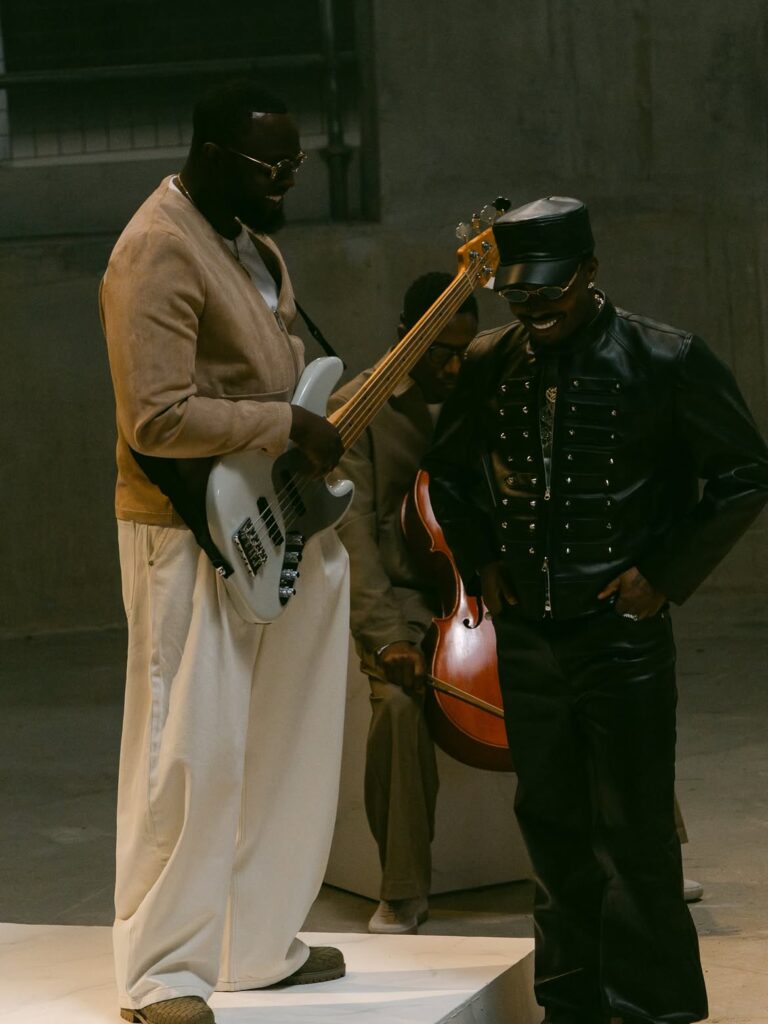
“Ultimately, a producer is somebody that creates,” he says. “And an executive producer is somebody who does it on a higher level. He oversees the overarching vision.” Then he shrugs off the title almost immediately. “I was always doing the stuff that an executive does, just without the official title.” The title, in many ways, simply caught up with the responsibility.
For Nana, executive producing M$NEY was less about authority and more about stewardship. He describes the role as a hands-on grind: selecting producers and engineers, arranging records, managing paperwork,
handling clearances, and ensuring contributors were properly credited.“The administration. The personnel.
The track selection. The structure. The sequence,” he says, listing the mechanics of the job. “You are guiding the entire ship from start to finish.” By the time Asake officially gave him the title, Nana says much of the work was already familiar. “That’s what we were already doing.”
Before M$NEY, before the massive achievements and stages, Nana’s first understanding of
music came from church. “As a lot of musicians and singers come from church, you don’t realize how much of an impact it makes on your musical appetite and development,” he says. “Your ability to associate chords and
sounds with feelings.”
That line stayed with me. To associate chords and sounds with feelings. The Church gave Nana that education before he even knew he was being taught. Music was printed into his memory through repetition, worship, congregation and emotion. Drums came first around the age of three. The keyboard followed around six. Then came the bass. For a long time, he assumed everyone experienced music the way he did.
“I thought everybody could do that,” he says. “I guess that’s what they say when you have a gift. You don’t realize it’s a gift.” What makes the story more surprising is that Nana never formally studied music. “I’ve never received any formal training in music,” he tells me. “I didn’t go to music school. I can’t read music.”
For a brief period, he even imagined a different future. He studied engineering at university and explored more traditional career paths before eventually accepting what everyone around him already seemed to know.
Music was not something he had chosen. It was something that had chosen him.
The bass eventually became the instrument through which he could translate himself most clearly. “There’s other bass players that I looked up to who I realized very quickly are the glue,” he says. “They’re the glue of every musical setup.”
Nana taught me what I did not know about this instrument. The bass is one of the few instruments responsible for both movement and emotion. It locks in with the drums while supporting the harmonic structure beneath the song, acting as the bridge between rhythm and melody.
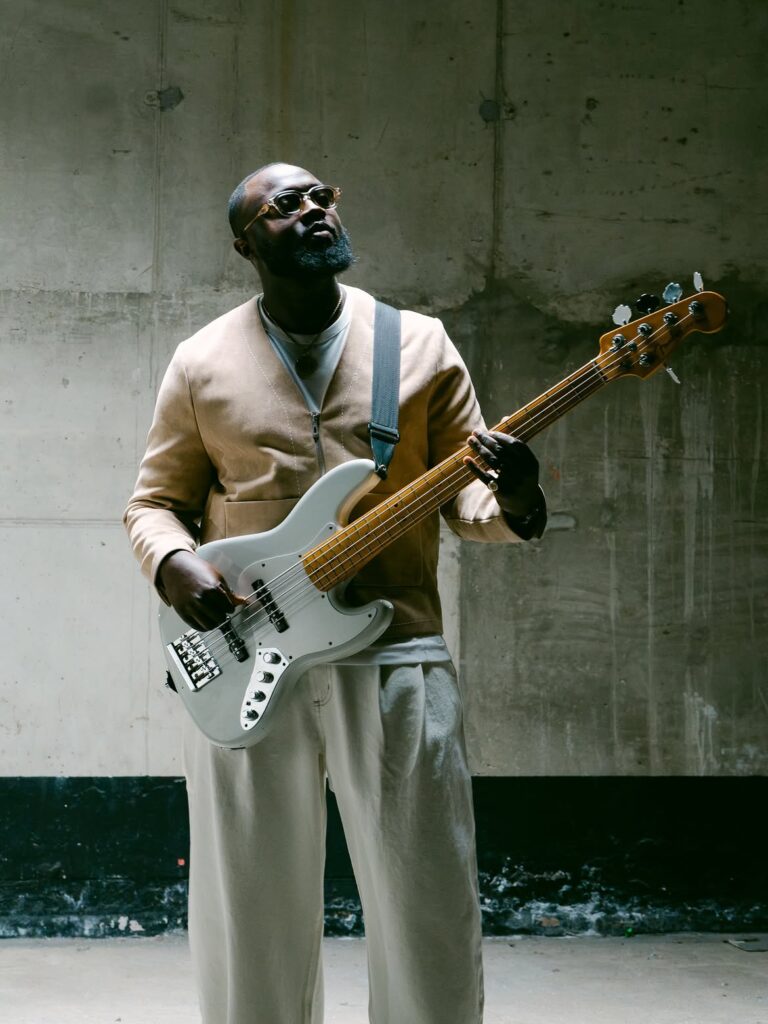
When I ask how the instrument mirrors his personality, he answers almost immediately. “I am always the person that is the glue of a situation.” That answer explains far more than his musicianship. It explains The Compozers.
The group’s origin story feels almost too organic for the industry it eventually entered. Nana and Brian, his manager, had wanted to launch an entertainment company. Their birthdays were a week apart, and their parties had become known for bringing people together. In 2013, they decided to launch the business on one of the biggest domestic boats in the UK. They wanted a DJ, they wanted a live band but they could not find anyone doing exactly what they imagined. So they became it.
“The phone hasn’t stopped ringing ever since,” Nana says. Before the world understood The Compozers as a band, they were simply friends. Nana’s father was a bishop, which meant access to church keys and instruments. Weekends became informal rehearsals
“We were just linking up and building a chemistry with each other.” When The Compozers first began touring with Fuse ODG, they spent four years moving across the UK and the world. Around that time, there were few African artists touring with live bands in that way.
Nana points to groups like The Roots and 1500 or Nothin’ as examples of what live musicianship could look like when treated as part of an artist’s identity rather than an accessory. “There was a gap in the market,” he says. “The world of Afrobeats didn’t have its own version of a band that could serve the music well and present it well and score it.”
Live instrumentation has always been part of the DNA of African popular music, even as contemporary Afrobeats increasingly embraced digital production. What The Compozers offered was not simply musicianship, but interpretation. “You want to serve the show correctly,” Nana says. “It’s not about just spotlighting musicians for
the sake of it.” For him, musicianship is not vanity. It is a service.
This is where The Compozers quietly changed expectations around African live performance. Not only through instruments, but through creative direction. Setlists. Transitions. Impact moments. Visuals. Stage placement. Understanding when a crowd needs release and when it needs tension. “It’s all about taking people on a journey.” That journey eventually led to Asake.
The Compozers first connected with him in 2022 during his earliest UK performances. From that point onward, they became almost inseparable musically. The O2, Madison Square Garden. Barclays Center, and the Red Bull Symphony.
“When we first started working with him, there was a lot of skepticism as to whether his music
could be interpreted live and still be infectious,” Nana says. “It just goes to show, it’s about
having the right people.”
That understanding eventually became central to M$NEY. For Nana, the album was never meant to exist separately from the world Asake had already built on stage. Years of live performance had already become part of his creative vocabulary. The crowds. The reactions. The moments that lingered.
“I’ve got a lifetime worth of experience on stage around the world,” he says. “So the decision making of certain arrangements or sound selections, whether it would be a good thing in the studio, allows us to challenge it in that direction.” Many producers create records, where Nana was helping create records that would eventually
have to live in arenas. When conversations around M$NEY began, he knew the album could not simply repeat what had come before.
“It needed to be a musically elevated version of what people had already known.” The goal was evolution without disconnection. The energy people loved in Asake’s music had to remain intact, but the musical world surrounding it needed to expand. Bigger. More intentional. More dimensional. A continuation of the live experiences audiences had already witnessed. This is where Nana’s stage experience became invaluable.
The studio and the stage, he explains, are two different disciplines. One asks how something sounds today. The other asks how it will feel in front of twenty thousand people six months from now.
On tracks like “Gratitude” and “Forgiveness,” he contributed bass performances while helping
shape the broader creative environment surrounding the project.
But his larger contribution was perspective, the ability to understand not only how a song would
sound, but how it would live.
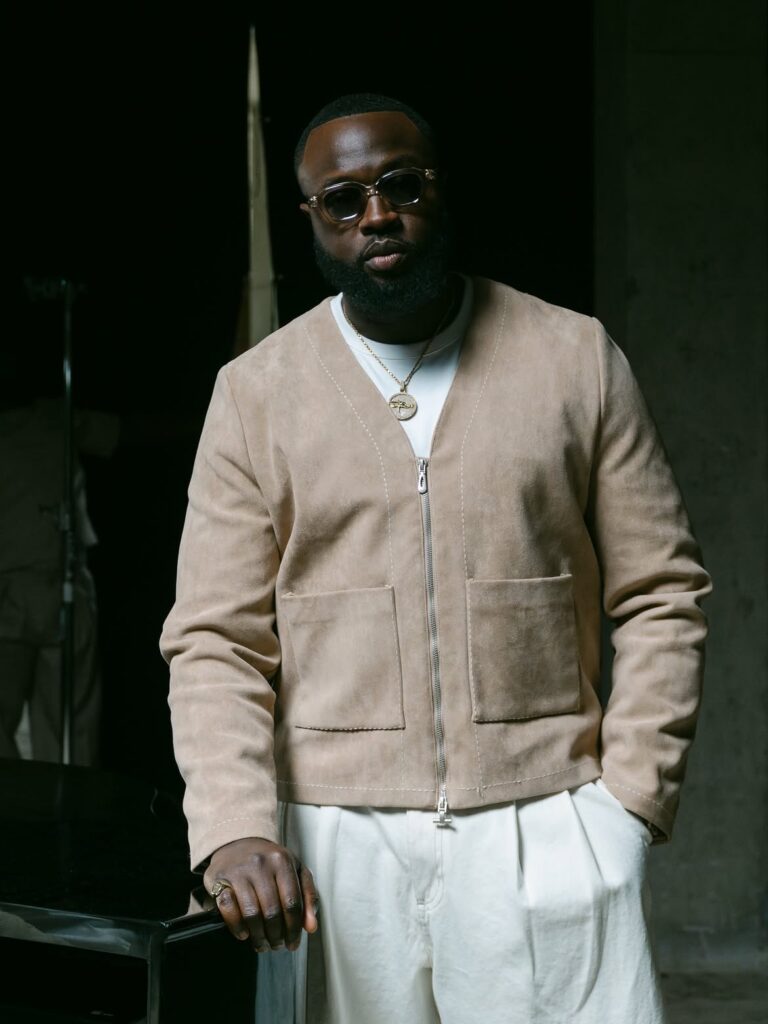
That perspective comes from years spent balancing instinct with discipline. “You have to trust yourself as a tastemaker,” he says. “You just need to be confident that whatever you’ve done, you’re happy with it.”
He pauses. “I’ve never been able to make the same thing twice. Music is capturing a particular moment. And
you’re not going to get that back.”
He remembers working on J Hus’ Common Sense during The Compozers’ early production years. Before the session, Nana had been listening to a Rick Ross record on the drive over. Once they got into the studio, ideas began to bounce around naturally. Someone played keys. Someone added drums. Nana picked up the bass. The record slowly revealed itself.
“At the time, I don’t think we fully realised what we were doing,” he says. Looking back, the experience reinforced something he still believes today. “Sometimes if you know too much, or become too much of a perfectionist, you end up making industry decisions as opposed to making music feeling decisions.” Music feeling decisions.
The phrase feels like a fitting summary of Nana’s career. Technical enough to understand the mechanics, experienced enough to understand the business, but always searching for the feeling first. That idea appears repeatedly throughout his career. He understood that people not only love the sound, but the nostalgia that sound carries.
“People always attach music to moments,” he says. “It’s the soundtrack of your life.” Which is why, when I ask what music has taught him about ego, his answer is immediate. “Leave your ego at the door. The best idea always has to win.” The best idea, he explains, rarely arrives where you expect it. That belief shaped the way he
approached M$NEY.
One of the things he speaks about most proudly is not a bassline or a production decision. It is
credits. “As a creative, a lot of times people get shortchanged and don’t get their dues,” he says. “The
most you can get out of a situation is your credit.” What interests him is not simply their musicianship. It is the way they used music as a vehicle to build systems, create opportunities and connect people.
For Nana, the future appears less about standing in front of crowds and more about helping
others reach them. Throughout our conversation he returns repeatedly to one idea: access.Why
credits, mentorship and opening doors matters. “I want to be able to give people opportunities,” he says.
In an industry that often celebrates visibility, Nana seems equally interested in recognition.
When I ask how he hopes to be remembered twenty years from now, “I want to be able to give people
opportunities. Be a connector.” And there it is again folks. The glue that is the bass, which undoubtedly was Nana from the start. Nana talks about his heroes with a distinct executive focus. He studies them like blueprints.
Adam Blackstone. Michael League. LA Reid. Jimmy Lovine. Babyface. Rance from 1500 or
Nothin’.
They represent different corners of the industry, yet all share a similar trait: a deep understanding of music as both art and infrastructure. They understand what happens in front of the crowd, but also what happens behind the scenes. The systems. The relationships. The opportunities. The decisions that shape careers long before audiences ever see the final product.
It becomes clear that Nana sees his future somewhere within that lineage. The bass will always be a part of his identity, just as The Compozers always will be. But there is another version of Nana beginning to emerge. One that thinks beyond arrangements and performances and toward building ecosystems, developing talent and creating opportunities for others. Executive producing M$NEY feels like a glimpse of a future that seems increasingly inevitable.
“People don’t realize the importance of pouring into other people,” he continues. “Open the door for others.”In an industry where so many people are fighting to be the face of something, Nana seems more interested in being useful to something. Throughout our conversation, he returns repeatedly to the same idea: service. Service to the artist. Service to the music.
Service to the people around him. It is the thread connecting the bassist, the executive producer, the mentor and the friend. If there is a philosophy underneath everything Nana builds, it is that success means very little if it
cannot create opportunities for someone else.
That mindset becomes most visible when he talks about Wembley Arena. The Compozers were completely independent. No major company behind them. No external entity manufacturing the moment, just a group of London boys who had built something from the ground up. “I’m there on the mic and playing the bass,” he says. “I told everybody, put your hands up, wave, wave, wave. And watching them, I had an out of body experience.”
How did I get here? The question still visits him, even now.
Despite the stages and mountains he’s crossed. “Who gave this guy a mic” he says, and in that moment I recognize myself and therefore a lot of us, imposter syndrome does indeed live on even in your greatest moments. A sign of humility and a deep understanding of the concept of gratitude.
The gift found its way to him through church keys borrowed on weekends, through drums played at three years old. Through basslines that connected rhythm and melody. Through friends who became a band. Through artists who needed someone capable of understanding the crowd before the crowd arrived.
When I ask him what recurring lesson life keeps teaching him, his answer feels almost deceptively simple.
“Be good to people.” That, he says, is the real wealth For The Compozers, the crowd has always mattered in a particular way. Their shows are built around the idea that the audience is not separate from the performance.
That is why, at Compozers shows, the crowd becomes more than an audience.
“The crowd is the fifth member,” he says. It may be the most beautiful summary of their philosophy. A band that understands music as communion. A bassist who understands that his job is to connect. A producer who understands that moments outlive metrics. An executive producer who understands that the best work often
begins with listening.
And Nana Pokes, whether on bass, in the studio, behind the boards, on stage, or somewhere quietly connecting the dots, has built a life out of knowing exactly when to listen. The Compozers call the crowd the fifth member. By the end of our conversation, I realized how often we have all been the fifth member. The person whose contribution is not always visible, but whose presence changes everything.
Few people understand the value of that role better than Nana Pokes. And perhaps that is why he has quietly become the fifth member in so many rooms himself.