In 2020, Gbots started learning music production and immediately noticed something unsettling. At every music production camp, networking event, or creative gathering she attended, she was often the only woman in the room. There were female artists and songwriters, sure, but music producers? She could count them on one hand.
“Most times when I go out for gatherings, music production camps, networking events, I’ll hardly see other women who are also music producers,” Gbots recalls. “I would see a lot of cool music production collectives, but it’s only guys that are there.”
The isolation was stark. Even when she actively searched for other female producers online, she came up empty. The first woman she found was on YouTube, just one. In 2021, an idea began to form: what if there was a space specifically for women who produce?
The Long Road to Formation
The concept of WeareproducHERs was born in Gbot’s mind in 2021, but turning that idea into reality took time. Finding women producers in Nigeria felt nearly impossible. “It was hard finding other women. It was really hard,” she admits. For years, she searched, reaching out to people online, asking around, trying to connect with the few women she could find.
The first person she messaged was a producer based in Lagos. Gbots went back through her Instagram DMs recently and found the message: “Do you know any other female producers? There’s something I am working on and would love to meet female producers. I produce too, been producing since last year June/July.” The producer she texted wasn’t particularly receptive, and looking back, Gbots understands why. “I don’t think I would have bought the idea of a collective either if somebody came to me with that. We’re not much.” She says with a laugh.
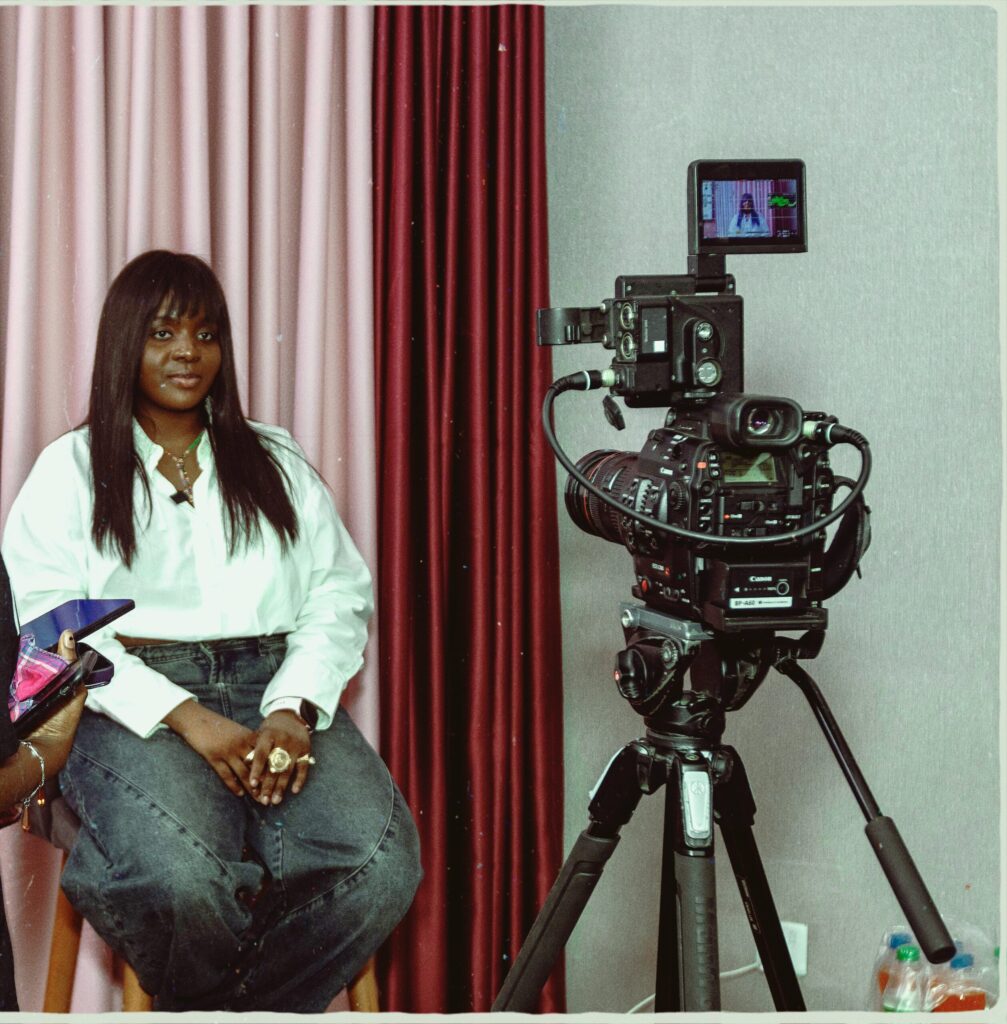
By 2023, after graduating from Babcock University, where she studied music, Gbots finally had the time to dig deeper. She started with three people: herself and two other women. They met online every Sunday at 3 p.m. on Discord to make beats together. But consistency was an issue. Gbots was often the only one to show up and push the idea forward regularly.
It became clear that a tight-knit collective wasn’t realistic yet. There simply weren’t enough women, and not everyone was equally committed. So the concept evolved. Instead of a collective, WeareproducHERs would be a community, open to any woman serious about music production as a career path. In January 2024, they held their first official meeting.
Why So Few Women?
The scarcity of women in music production isn’t accidental. Gbots traces it back to upbringing and societal conditioning. “From the upbringing of so many women, you learn that guys should do the physical and technical part. Fix the generator, wash the car. And for women: wash plates, cook. You could just see the difference in what they would say the ideal work for a man should be and what the ideal work for a woman should be.”
Music production is technical. It requires understanding software, engineering, and sound design. The same conditioning that steers women away from technical fields in general steers them away from the backend of music. “You see more women who are artists than people who actually engineer or even DJ, the technical parts of the work,” Gbots explains.
Even now, the numbers tell the story. At a music camp just recently, a guy told Gbots she was only the second female producer he’d ever met. “I told him we’re more than that. But we’re still little. We can still count how many we are.”
From Saxophone to Music Production
Gbots didn’t set out to become a producer. She grew up singing in church and playing the saxophone, an instrument her music teacher encouraged her to learn.
When she got to Babcock University to study music, her goal was to be a performer, someone who played live and did gigs. She had no idea how music was actually made. “For someone who has been doing music for a long while, performing, singing in church, I never knew how people actually made music. How they recorded or how they made beats. My own was just to go to church, play my sax, or if they call me for a gig, I’ll play my sax and do my thing.”
The big moment came during her first year, second semester, right before COVID shut everything down. She was in her school chapel watching the pianists use FL Studio to create backing tracks for worship performances. On the day everyone had to leave campus because of the virus, students were transferring files, movies, and random stuff. Gbots grabbed FL Studio from her friend. She doesn’t even know why. “It was very random. I just collected the software.”
During the lockdown, she taught herself. YouTube videos, trial and error, messaging a friend who was also learning, and sending each other beats. By her second year, when it was time to choose a major, she already had a foundation. She picked Advanced Digital Media, which covered beatmaking and engineering. “That’s how I started. It was very random. But I’d always been doing music since I was little, dabbling in it here and there.”
Building the Community
WeareproducHERs currently has 15-18 members, including both producers and songwriters. Gbots is deliberate about who joins. “We don’t just want artists who produce. We want women who actually see music production as a profession, not as a side gig or something they just take an interest in. We want people who have music production as a priority first, even if they are doing anything else.”
The community operates online and offline. They have a Discord server where members stay connected, share work, and hold each other accountable. They collaborate with other collectives like 44DB, learning from their experiences and building networks across the industry. Gbots is close with 44DB’s founder, someone she calls when she can’t figure something out. “He has done something like this, so I just learn from his experiences. We just bounce off each other.”
On the 22nd of November 2025, WeareproducHERs held their first workshop. It wasn’t about the space or the event production value for Gbots.”The most important thing for me was: did the women that came to learn actually learn what they came to learn? And they did. They had fun. They also interacted with a lot of us,” she says. The next workshop might be planned for one or two weeks, giving participants more mentorship and time to absorb the material.
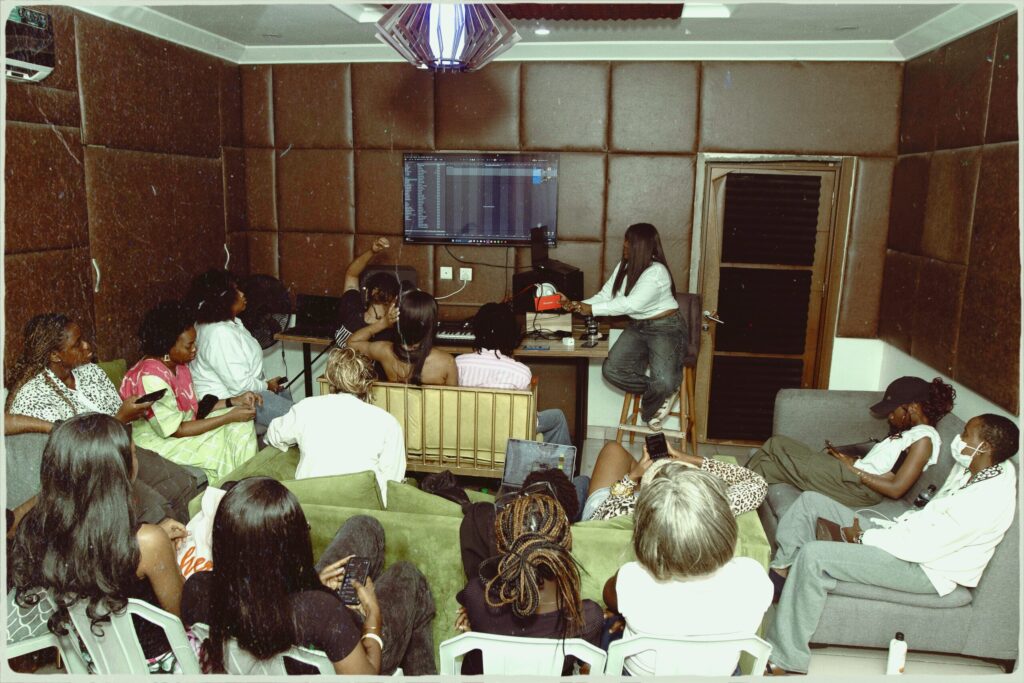
The selection process for the workshop was intentional. They didn’t want people already deep in the music industry. “There was someone who owned a security agency, another person was a makeup artist, and we even had an actress. Basically, the aim was to get people doing creative stuff, not necessarily in the music space, because we actually want people who see music production as an actual career path.”
The Challenges
Finding women remains the biggest obstacle. Even when Gbots finds them, convincing them that music production is a viable career takes work. “Most women won’t just see it as something that’s sustainable or something they actually want to make their career path,” she says. The conditioning runs deep.
Funding has been another hurdle, though partnerships with companies like Greywoulfe, the media company they work with now, have helped ease that burden. Greywoulfe has been supportive, providing resources for making music and creating content.
But the tide is turning. More women are entering music production now than when Gbots started in 2020. The numbers are still small, but they’re growing. “There are more people now. We should be about 18.” It’s not much, but it’s progress.
The Vision
Gbots has three core goals for WeareproducHERs: visibility, collaboration, and community. She wants a future where you can’t count the number of female music producers in Nigeria. “I want to be like, if someone asks me how many female music producers I know, I should not be able to name everybody or say a number like 20 or 25. There should be a lot of them.”

More than that, she wants women at the forefront of the biggest songs. “Top 10, I want to see so many women producers in the top 10 charts. Just more visibility, collaborations amongst ourselves, and community.”
There’s a project in the works for next year, something the community is putting together now. The details are still forming, but the intention is clear: to keep pushing, building, and making space for women who produce.
A Name with Meaning
The name WeareproducHERs came from Gbots’ sister, who has been supportive of the idea from the beginning. It’s a deliberate play on words, feminising “producers” while maintaining the essence of what they do. It’s catchy, memorable, and makes a statement: women produce too.
As the conversation winds down, Gbots reflects on how far things have come since 2021, when she was searching alone for just one other woman producer. Now there’s a community. Now there are workshops. Now there are collaborations and partnerships and a Discord server full of women making beats, engineering tracks, and building careers.
It’s still a long road. The numbers are still small. The industry is still overwhelmingly male-dominated, but WeareproducHERs is here, growing steadily, proving that women belong in every part of music, including the technical side that’s been gatekept for far too long.
“It’s a normal thing now,” Gbots says. “It’s getting very normal.”
Not so long ago, she was the only woman in the room. Now she’s building the rooms where that will never be true again.